

My '65 S type (with an early Mk2 3.8 engine) has a vacuum leak which has progressively worsened over the last few months. To the point I'm uncomfortable that the mixture is weakening.
The early symptom was the air intake flap would close fairly quickly after stopping the engine and now doesn't even open.
The flap went through a stage of closing when the throttle was floored and then popping back up when backing off. Which was slightly reminiscent of a Ford 100E I had many years ago and its hilarious windscreen wipers. Proving my point that the only good Ford is one on a banger track (where this 100E ended up).
Anyway, that aside, what would be your prime suspect component to go looking at? I have a view that the vacuum reservoir would be a good starting point but is there a more usual failure point?
Thanks.
Vacuum Leak
Moderators:Aceman, ecosselynx

Re: Vacuum Leak
Hello Simon,
I know MK 2 vacuum reservoirs can rust quite badly, other than that hoses and the non return valve fitted to the reservoir?
Alec
I know MK 2 vacuum reservoirs can rust quite badly, other than that hoses and the non return valve fitted to the reservoir?
Alec
Mk 2 3.8 (long term restoration), MK1 Triumph 2.5 P.I. , 564 Hymer Motorhome
Re: Vacuum Leak
Hi Simon,
You are right to be concerned for the seizure of the rear cylinder, I warned a member of our local club with an S type that was loudly hissing. He ignored my advise to get it fixed ASAP took it down the motorway and floored it, he didn't get far as the cylinder seized.
I would have thought the best thing was to follow your ears! At idle with the throttles shut it will be loudest, the tapping is ontop at the rear of the inlet manifold on an early 3.8 and I believe similarly on the later manifolds.
As Alec says the vacuum tank under the drivers wheel arch often rots out, but there will be other possible leak points along the way, plus whatever has been added to for your heater and other flap controls. Any old rubber plus the tank are favourites.
This vacuum leak will affect your brake servo, so how good are they now??
Best Wishes
Brian
PS I ran for years without a vacuum tank (blood expensive) but when I servoed the clutch I added a reservoir for the brake side, one of the small gas bottles for mig welding (that won't rot out in a hurry).
You are right to be concerned for the seizure of the rear cylinder, I warned a member of our local club with an S type that was loudly hissing. He ignored my advise to get it fixed ASAP took it down the motorway and floored it, he didn't get far as the cylinder seized.
I would have thought the best thing was to follow your ears! At idle with the throttles shut it will be loudest, the tapping is ontop at the rear of the inlet manifold on an early 3.8 and I believe similarly on the later manifolds.
As Alec says the vacuum tank under the drivers wheel arch often rots out, but there will be other possible leak points along the way, plus whatever has been added to for your heater and other flap controls. Any old rubber plus the tank are favourites.
This vacuum leak will affect your brake servo, so how good are they now??
Best Wishes
Brian
PS I ran for years without a vacuum tank (blood expensive) but when I servoed the clutch I added a reservoir for the brake side, one of the small gas bottles for mig welding (that won't rot out in a hurry).
MY2000 3ltr S type manual standard car with leather seats, cruise control and mistral blue metallic paint.
1961 3.8 MkII manual, Indigo blue, nolonger runs on LPG, everything else uprated
1961 3.8 MkII manual, Indigo blue, nolonger runs on LPG, everything else uprated
Re: Vacuum Leak
Well Simon, there's interesting ,as they say.
The S type has two vacuum tanks, one for the brakes and one for the heater system. These are totally separate. EXCEPT they share a common vacuum hose from the engine to a T piece hose joint near the brake vacuum tank - which goes to the heater system vacuum tank
So lets concentrate on the heating system.
The heater control vacuum tank which is a quarter of the size of the brake system vacuum tank is supposed to be under the left hand wing. It's forty odd years ago that I owned mine and just cannot visualise ever having seen this tank.
You explained that the inlet flap on the scuttle was bobbing up and down depending on the vacuum available. Well, that is an excellent sign , it tells us that the flap is free to move and that the vacuum flap actuator is working. From your description I would go for the non-return valve on the tank. The brake vacuum tank is mounted on the crows foot shaped member that supports the lower part of the front wing and is hidden behind a stone shield and I would guess that the heater system vacuum tank is mounted in a similar manner under the left wing.
As Martec has already suggested it is a crap job cos it collects all the road dirt. There is every possibility that area has been previously attended too , even so , I would not be surprised to find the area corroded so be prepared for some serious work. Like ,new tank, non -return valve and hoses.
Meanwhile, give very serious consideration to Martec's comment in regard to engine damage.
Let us know how you get on and come back if you need more
Oldtimer
PS Will you be doing this your self ?
The S type has two vacuum tanks, one for the brakes and one for the heater system. These are totally separate. EXCEPT they share a common vacuum hose from the engine to a T piece hose joint near the brake vacuum tank - which goes to the heater system vacuum tank
So lets concentrate on the heating system.
The heater control vacuum tank which is a quarter of the size of the brake system vacuum tank is supposed to be under the left hand wing. It's forty odd years ago that I owned mine and just cannot visualise ever having seen this tank.
You explained that the inlet flap on the scuttle was bobbing up and down depending on the vacuum available. Well, that is an excellent sign , it tells us that the flap is free to move and that the vacuum flap actuator is working. From your description I would go for the non-return valve on the tank. The brake vacuum tank is mounted on the crows foot shaped member that supports the lower part of the front wing and is hidden behind a stone shield and I would guess that the heater system vacuum tank is mounted in a similar manner under the left wing.
As Martec has already suggested it is a crap job cos it collects all the road dirt. There is every possibility that area has been previously attended too , even so , I would not be surprised to find the area corroded so be prepared for some serious work. Like ,new tank, non -return valve and hoses.
Meanwhile, give very serious consideration to Martec's comment in regard to engine damage.
Let us know how you get on and come back if you need more
Oldtimer
PS Will you be doing this your self ?
Re: Vacuum Leak
Neither can I - I've skived off work, sorry "working from home", today so when I've girded my loins to go outside I'll have a poke about. I can't recall seeing the heater system tank either - and I've owned the car for seven years!Well Simon, there's interesting ,as they say.
The S type has two vacuum tanks, one for the brakes and one for the heater system. These are totally separate. EXCEPT they share a common vacuum hose from the engine to a T piece hose joint near the brake vacuum tank - which goes to the heater system vacuum tank
So lets concentrate on the heating system.
The heater control vacuum tank which is a quarter of the size of the brake system vacuum tank is supposed to be under the left hand wing. It's forty odd years ago that I owned mine and just cannot visualise ever having seen this tank.
That the two systems are separate is helpful as the brakes appear to be ok and I can easily isolate the heater side if obtaining the parts proves a pain. The hot water valve had to be replaced some years ago with a manual tap a la Morris Minor - it's on the list of things to do. I believe an XJ6 valve fits but works in reverse.
Meanwhile, give very serious consideration to Martec's comment in regard to engine damage.
Yes, other than welding I can do pretty much everything - the only fly in the ointment is I've very recently moved house and my workshop is 15 miles away with very little easily accessible. Hey, ho!PS Will you be doing this your self ?
Simon
Brighton
Sussex
Brighton
Sussex
Re: Vacuum Leak
The culprit!
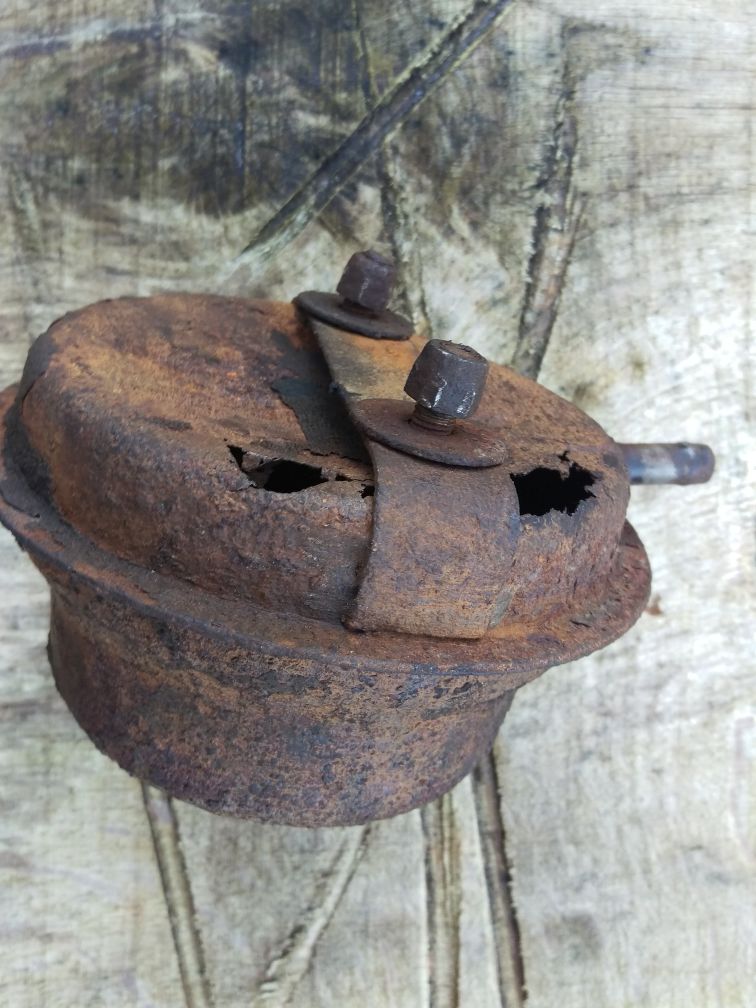
I've blanked off the reservoir supply, so it no longer leaks, the flap operates (but only when the engine is running) and it idles a lot better.
Now to find someone who can weld/braze a repair.
I've blanked off the reservoir supply, so it no longer leaks, the flap operates (but only when the engine is running) and it idles a lot better.
Now to find someone who can weld/braze a repair.
Simon
Brighton
Sussex
Brighton
Sussex
Re: Vacuum Leak
Hello Simon,
I don't think I would bother repairing that, the rust is extensive so it is unlikely to last. Surely they can't be that expensive to replace or find an alternative vessel?
Alec
I don't think I would bother repairing that, the rust is extensive so it is unlikely to last. Surely they can't be that expensive to replace or find an alternative vessel?
Alec
Mk 2 3.8 (long term restoration), MK1 Triumph 2.5 P.I. , 564 Hymer Motorhome
Re: Vacuum Leak
As far as I can tell they are utterly unattainable.I don't think I would bother repairing that, the rust is extensive so it is unlikely to last. Surely they can't be that expensive to replace or find an alternative vessel?
I could bodge a reservoir off another vehicle in position or get something fabricated but the rust is not that bad. It's just that area that's thin, the rest sounds quite, er, sound.
Certainly as a temporary measure (which may become permanent) I need to source something off another car (XJ6?) - any ideas?
Simon
Brighton
Sussex
Brighton
Sussex
Re: Vacuum Leak
Simon
Source an air brake tank off a truck or trailer. Their side walls are quite thick and easy to attach brackets. They come in dozens of sizes and you may be able to source a new one cheaper than might be expected. A truck scrap yard should also be able to supply you as there is very little demand for the air tanks.
Source an air brake tank off a truck or trailer. Their side walls are quite thick and easy to attach brackets. They come in dozens of sizes and you may be able to source a new one cheaper than might be expected. A truck scrap yard should also be able to supply you as there is very little demand for the air tanks.
Re: Vacuum Leak
Simon,
You need a miracle worker not a welder to repair that knackered tank - bin it.
Lets see what the options are :- but firstly, tell us , was the tank under the front wing, same as the brake tank position only the opposite side ?
1 You could modify an old Brass Pyrene Fire extinguisher but they are probably rarer than the replacement tank that you are after.
2 The Series One and Two XJ 6 AND 12 and XJ-S have an almost identical tanks to yours. The beauty is that the tank is hidden away and possibly in perfect condition. For a small fee I'll tell you where it is !
Difficult to explain - Standing with your knees against the front bumper look to the back left hand corner of the engine bay (yes right in the corner) and there is a small aperture which gives access beneath the wing, and the tank is hidden in there.
3. The other alterative is to try and obtain one of the following Tank Part No's
XJ6 Series One BD34695
XJ6 Series Two C39521
XJ6 Series Three CAC2526
XJ - S -Early CAC5009 (CAC2528)
Hope that helps a bit
Oldtimer
You need a miracle worker not a welder to repair that knackered tank - bin it.
Lets see what the options are :- but firstly, tell us , was the tank under the front wing, same as the brake tank position only the opposite side ?
1 You could modify an old Brass Pyrene Fire extinguisher but they are probably rarer than the replacement tank that you are after.
2 The Series One and Two XJ 6 AND 12 and XJ-S have an almost identical tanks to yours. The beauty is that the tank is hidden away and possibly in perfect condition. For a small fee I'll tell you where it is !
Difficult to explain - Standing with your knees against the front bumper look to the back left hand corner of the engine bay (yes right in the corner) and there is a small aperture which gives access beneath the wing, and the tank is hidden in there.
3. The other alterative is to try and obtain one of the following Tank Part No's
XJ6 Series One BD34695
XJ6 Series Two C39521
XJ6 Series Three CAC2526
XJ - S -Early CAC5009 (CAC2528)
Hope that helps a bit
Oldtimer
Re: Vacuum Leak
I fear you are correct.Simon,
You need a miracle worker not a welder to repair that knackered tank - bin it.
Yes.Lets see what the options are :- but firstly, tell us , was the tank under the front wing, same as the brake tank position only the opposite side ?
Yes it does.3. The other alterative is to try and obtain one of the following Tank Part No's
XJ6 Series One BD34695
XJ6 Series Two C39521
XJ6 Series Three CAC2526
XJ - S -Early CAC5009 (CAC2528)
Hope that helps a bit
They look very similar just minus the bracket. I can use the hoses to hold it in position (which I think the XJ6 must do) or swap over the original bracket onto the XJ6 tank.
Simon
Brighton
Sussex
Brighton
Sussex
Re: Vacuum Leak
I am surprised that we Jaguar Enthusiasts enjoy knocking Ford. That company saved Jaguar and probably built the very best Jaguar since Bill, the X300! I am,of course, biased since I was reared in Coventry, was apprenticed at Humber-Hillman and worked for Ford for 27 years.
Re: Vacuum Leak
I never worked for Ford but over the years have read a great deal about Fords achievements.
Back in the 1930's Ford introduced flow line production methods which revolutionised motor car production and influenced the world. They even manufactured Rolls Royce Merlin Aero engines in Manchester during the war. It is sad that they will be remembered for producing a vehicle with a dodgy wiper motor.
I could go on but better stop
Back in the 1930's Ford introduced flow line production methods which revolutionised motor car production and influenced the world. They even manufactured Rolls Royce Merlin Aero engines in Manchester during the war. It is sad that they will be remembered for producing a vehicle with a dodgy wiper motor.
I could go on but better stop
Re: Vacuum Leak
"I sleep with one sheep..."I never worked for Ford but over the years have read a great deal about Fords achievements.
Back in the 1930's Ford introduced flow line production methods which revolutionised motor car production and influenced the world. They even manufactured Rolls Royce Merlin Aero engines in Manchester during the war. It is sad that they will be remembered for producing a vehicle with a dodgy wiper motor.
Simon
Brighton
Sussex
Brighton
Sussex
Who is online
Users browsing this forum: No registered users and 4 guests